The IB Diploma Decoded: Study Strategies, Support Systems, and What Top Scorers Do Differently
Every year, tens of thousands of students take on one of the most demanding pre-university programmes available: the International Baccalaureate Diploma Programme.
Six subjects studied simultaneously. A 4,000-word Extended Essay. A Theory of Knowledge course. Creativity, Activity and Service requirements. All compressed into two intensive years, and recognized by universities across more than 150 countries.
For many students, the IB is the first academic challenge that genuinely tests the limits of what classroom support alone can provide. This guide is about what the programme demands, and what effective preparation actually looks like.
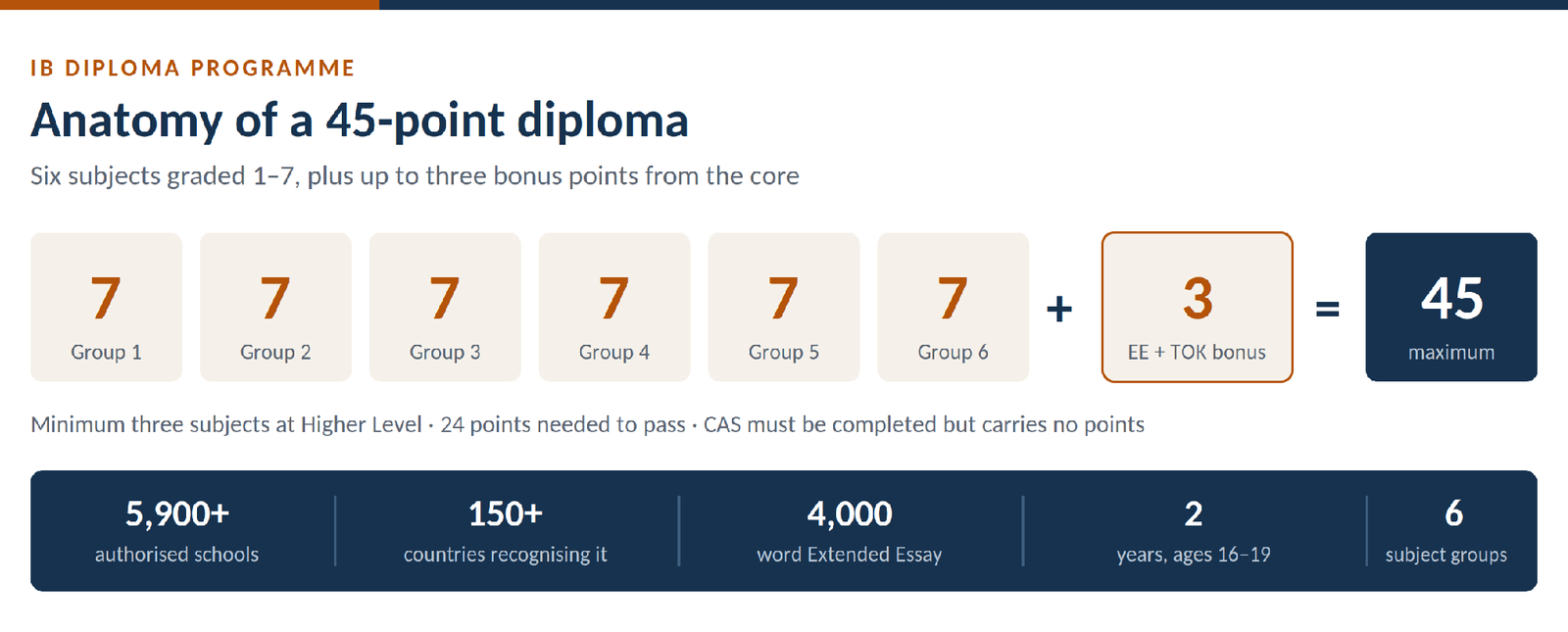
Figure 1: The IB Diploma Programme is taught in over 5,900 authorized schools worldwide and recognized by leading universities across 150+ countries.
Start With the Arithmetic, Not the Syllabus
Most students meet the IB as a list of tasks. It is more useful to meet it as a scoring system, because that is what determines where your revision hours should go.
| Component | Points available | When it is decided |
|---|---|---|
| Six subjects, graded 1–7 | 42 | Exams plus Internal Assessments |
| Extended Essay + Theory of Knowledge | 3 | Submitted before final exams |
| Creativity, Activity, Service | 0 | Must be completed to pass |
| Maximum diploma score | 45 | 24 points required to pass |
Two things follow from that table, and both change how you should plan:
- A large share of your marks is banked before you sit a single final paper. Internal Assessments and the EE are finished and graded while you are still in the middle of the course.
- CAS earns you nothing but can cost you everything. It carries zero points and still blocks the diploma if incomplete.
What the Two Years Actually Ask of You
The programme is built around six subject groups: Studies in Language and Literature, Language Acquisition, Individuals and Societies, Sciences, Mathematics, and the Arts. At least three must be taken at Higher Level.
Higher Level is not just ‘the harder version’
HL courses carry substantially more content depth, more analytical demand, and more contact hours than their SL equivalents. But SL grades count exactly the same toward your total. A 5 in SL Chemistry costs you the same two points as a 5 in HL Physics.
Running alongside the six subjects are three core components. The Extended Essay is a self-directed research paper of up to 4,000 words. Theory of Knowledge asks you to examine how knowledge itself is built across disciplines. CAS covers creativity, activity and service.
Students who understand this full shape from the first term of Year 12 consistently outperform those who meet each component reactively, one deadline at a time.
Where Classroom Support Runs Out of Room
The IB is taught in authorized IB World Schools, and the standard of teaching in most is genuinely high. The constraint is rarely quality. It is simultaneous.
One student, six subjects, multiple HL Internal Assessments, a 4,000-word essay and a TOK presentation — all moving at once. No single teacher, however capable, can hold all six of those threads for thirty students at the same time.
This is the gap that specialist support fills. Experienced IB tutors who work with the programme’s assessment criteria, Internal Assessment structures and examiner conventions bring a level of subject precision that a timetabled classroom rarely has the bandwidth to deliver consistently across all six subjects.
The value is not mainly content. IB examiners are highly specific about what they reward:
- In Biology HL, precise scientific vocabulary in Paper 3 outscores identical understanding expressed in general language.
- In History HL, examiners look for structural conventions most students never learn without being shown them.
Knowing those conventions and applying them reliably under timed pressure is what separates an average IB candidate from a strong one.
Timing compounds the effect. Students who bring in subject-specific help during Year 12, rather than the final months before May exams, have time to internalize IB writing conventions and close conceptual gaps before they harden.
Balancing HL and SL Revision
The most consequential planning decision in the IB is how you split time across HL and SL. HL demands more, but SL points are worth the same — and a student who pours everything into HL often finds modest SL results quietly pulling the total below target.
- Set an honest target grade for each of your six subjects, not an aspirational one.
- Estimate the practice hours each of those targets realistically needs.
- Schedule proportionally from those numbers rather than from personal preference.
Past paper practice is the most efficient revision tool in every IB subject. Work timed, mark against the official markbands immediately, and keep a running record of which question types cost you marks most often. Deliberate identification and targeted re-practice is what moves a student off a plateau at 5.
The Extended Essay and Theory of Knowledge
Both are routinely treated as background tasks until a deadline turns them into emergencies.
- The EE needs a focused, answerable research question, a coherent argument, and properly evaluated evidence. Starting in Year 12 buys time to refine the question and get substantive supervisor feedback before the deadline applies pressure.
- TOK is not peripheral. Students who engage with it seriously tend to perform better across their HL subjects too, because the analytical habits it builds are exactly what examiners reward elsewhere.
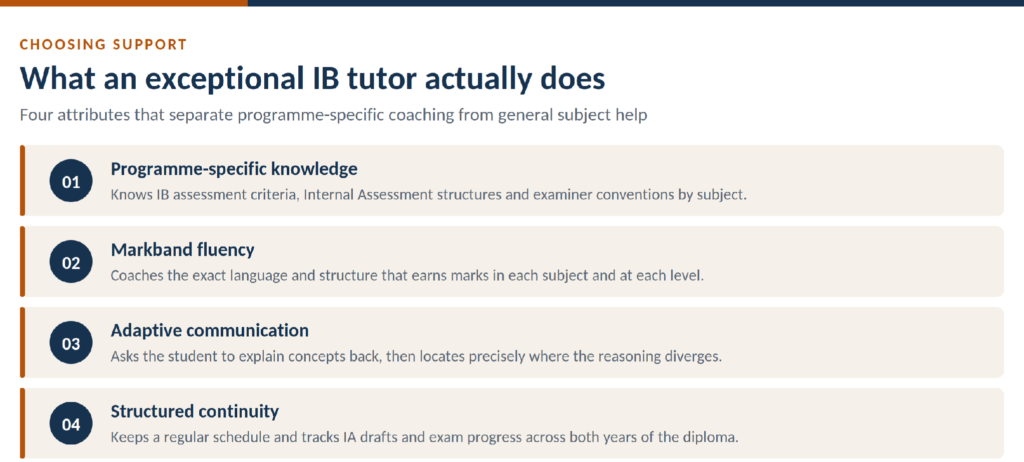
Figure 2: Four attributes that distinguish high-impact IB tutors from those who deliver general subject support.
What Defines an Exceptional IB Tutor
Finding a strong subject teacher and finding an effective IB tutor are different problems. Internal assessments, markbands and examiner conventions mean IB-specific expertise matters at least as much as subject fluency.
- Programme-specific knowledge. Understands the difference between markband descriptors at grade 4 and grade 6, and knows how IB examiners approach Internal Assessment moderation.
- Markband fluency. Most lost marks are not lost to misunderstanding but to writing in language the markband does not reward. Ask a prospective tutor how they coach students to hit specific criteria, using a past paper question from your own subject.
- Adaptive communication. Explains a concept several ways and asks the student to articulate it back. Locating exactly where reasoning diverges beats restating the textbook.
- Structured continuity. IB preparation spans two years. A tutor who logs session content, follows up on IA drafts and revisits earlier material delivers far more than one treating each session in isolation.
Getting Full Value From Official IB Materials
The IB publishes a considerable range of student-facing material, and most candidates use a small fraction of it — defaulting instead to commercial revision guides.
Worth going to first:
- Official subject guides
- Specimen examination papers
- Past markbands and assessment criteria
- Internal Assessment exemplars
The IB’s own Diploma Programme curriculum documentation sets out the full structure, the assessment framework and the requirements of each subject group. Reading it for your own subjects gives you a far more granular map of what is expected than commercial materials typically reflect.
For each subject the IB also publishes the official criteria and markbands. These describe, in the organization’s own words, exactly what separates one grade from the next. Working through them — particularly alongside someone who can translate the official language into practical revision priorities — is a precision advantage third-party materials rarely match.
Past papers paired with official markschemes give you the question exposure and marking insight to improve under timed conditions. Reading examiner reports for your highest-priority subjects stays one of the most efficient uses of revision time at any stage.
The Subjects That Stretch Students Most
Certain subjects generate outsized difficulty, usually because the gap between what students expect and what the assessment requires is widest there.
- Mathematics: Analysis and Approaches HL. Widely regarded as the most demanding standard subject by score distribution. The difficulty is not individual concepts but multi-step reasoning in Paper 1, taken without a calculator, and the formal proof requirements in Paper 3. Consistent timed practice with worked solutions, started early, is the only approach that reliably works.
- Sciences at HL. Physics, Chemistry and Biology all demand accurate recall plus fluent scientific language in extended answers. Many students who understand the science still lose marks because their writing lacks the specificity HL markbands require.
- Groups 1 and 2: Languages. The formal demands of HL language subjects are routinely underestimated, especially the Paper 1 literary commentary and the Individual Oral. Both improve substantially with deliberate, feedback-rich practice rather than passive reading.
What Grade 7 Students Do Differently
Students who consistently reach grade 7 are not uniformly more able than those at 4 and 5. They share habits that compound across two years.
- Active recall over passive revision. Closing notes and retrieving from memory, then checking accuracy, beats reading and highlighting in every credible study of retention. Flashcards, practice questions and self-testing are the tools of choice at the top of the cohort.
- Reading the markband before writing. They do not write a practice essay and then check the criteria. They read the markband first and build the response deliberately, which closes the gap between what a student thinks a good answer looks like and what the examiner rewards.
- Starting Internal Assessments early. IA grades are locked in before the final exam series, so marks lost there cannot be recovered later. Early drafts revised on teacher feedback tend to produce a cushion in the overall score.
- Protecting the Extended Essay. The EE is the component most damaged by procrastination. Refined early and researched consistently, it typically earns an A or B. Chosen late and written under pressure, it tends toward a D — points that cannot be earned back.
Conclusion
The IB rewards students who understand it as a single system rather than six separate subjects with three added tasks. That systemic view, developed early and supported by the right people, is what separates candidates who finish with the score their university asked for from those who fall short despite working hard.
A two-year sequence that works
Year 12, term 1 — map the full assessment structure for all six subjects and set target grades.
Year 12, term 2 — refine the EE research question and begin IA drafts.
Year 12, term 3 — start timed past paper practice against official markbands.
Year 13 — consolidate IAs, submit the EE early, and shift fully to exam technique.
In the IB, timing is rarely neutral. Early investment in the right preparation almost always returns more than last-minute effort can replicate.
