Time Zone Is No Longer an Excuse: How Indian Developers Are Powering 24/7 Startup Velocity
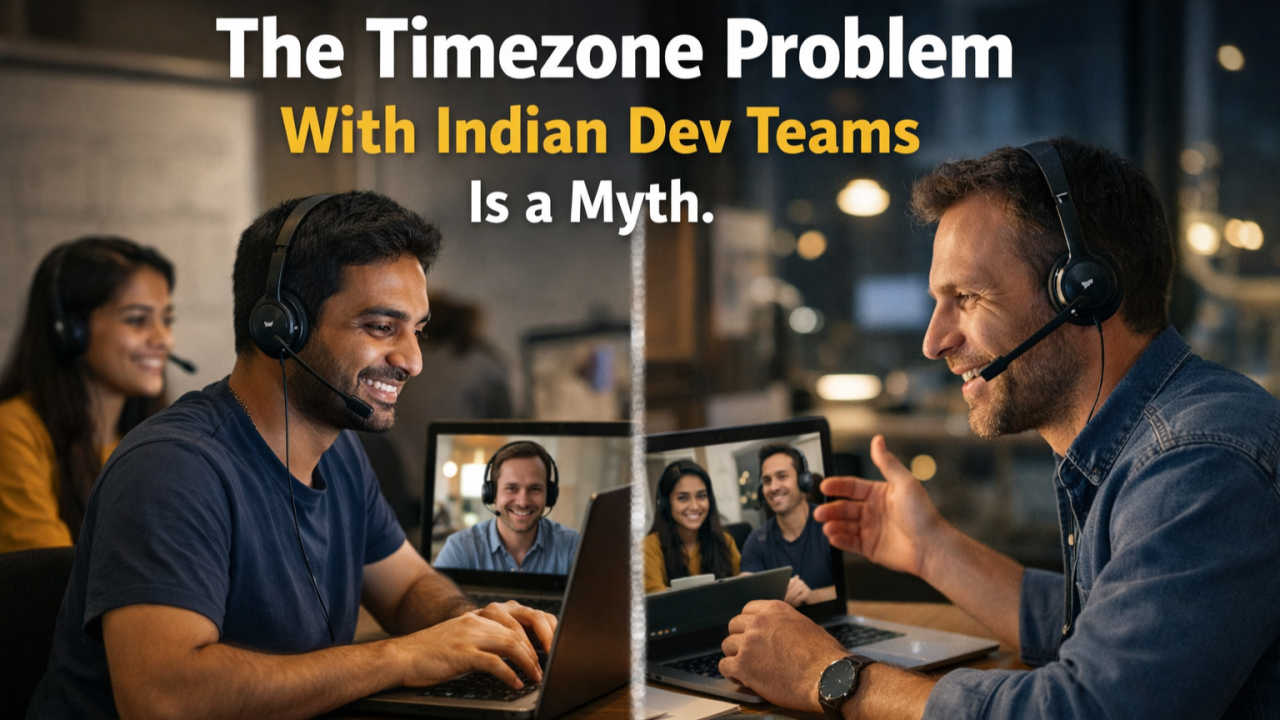
There is a conversation that happens in almost every founding team the first time they consider hiring developers from India. It usually goes something like this: “The talent looks great. The cost makes sense. But the time zone…” And then the sentence trails off, because nobody quite wants to say it out loud that a 9.5 to 13.5 hour difference between India Standard Time and US time zones feels like a dealbreaker.
It is not. And the startups that figured this out first are now pulling ahead of competitors who are still waiting for everyone to be online at the same time.
The time zone gap between the US and India is not a logistics problem to be solved. For the startups that understand how to leverage it, it is a 24-hour product engine one that the right AI hiring platforms are now making accessible to any founder willing to think differently about how their team operates.
The Myth That Killed a Decade of Opportunity
The time zone objection has its roots in a legitimate concern but one that belongs to a different era of remote work. In the early days of distributed teams, collaboration meant real-time communication: everyone on the same call, at the same time, working through problems together synchronously. If your team was not online simultaneously, work stalled.
That model of remote work is obsolete. The best distributed teams in 2026 the ones shipping fastest, iterating most effectively, and scaling most efficiently are built on async-first principles. They document decisions. They use structured handoffs. They do not rely on everyone being available at the same moment to make progress.
Indian developers, who have been operating in distributed and async-first environments for years, are among the most naturally equipped professionals in the world for this mode of work. The time zone is not their disadvantage. For teams that know how to use it, it is their superpower.
What 24/7 Velocity Actually Looks Like
Let us make this tangible. A US-based startup with an Indian engineering team operates when structured correctly as a continuous development engine. Here is what a single working day can look like:
- The US product team wraps up at 6 PM Pacific, leaving detailed tickets, priorities, and context for the next sprint block
- The Indian engineering team picks up at 7:30 AM IST which is 7 PM Pacific and works through the night US-time
- By the time the US team wakes up, features have been built, bugs have been fixed, and PRs are waiting for review
- A 2–3 hour daily overlap window typically early morning US time and late evening IST allows for synchronous standups, alignment calls, and any real-time collaboration that genuinely requires it
The result is a startup that does not stop when the US office closes. Code is being written while founders sleep. Bugs are being fixed before US customers wake up to report them. Features are being shipped on a clock that never pauses.
That is not a workaround for the time zone gap. That is the time zone gap working for you.
Why Most AI Hiring Platforms Miss This Entirely
Most AI hiring platforms treat remote hiring as a sourcing problem but not Uplers. Find the candidate, make the match, collect the fee. What they do not account for is the operational reality of integrating a distributed team the communication rhythms, the handoff structures, the async tooling, the cultural nuances that determine whether a remote hire thrives or quietly underdelivers.
This gap is where most failed remote hires originate. Not from lack of technical skill but from lack of preparation for the distributed work context. A developer who is exceptional in a co-located office environment may struggle without the right async habits, communication discipline, and ownership mindset that remote-first startup work demands.
Uplers screens explicitly for this. Remote-work readiness is not an afterthought in the vetting process it is a core evaluation criterion, equal in weight to technical skill. Every developer who makes it through Uplers’ screening has demonstrated the async communication habits, self-direction, and professional discipline that distributed startup teams need to move fast without breaking apart.
The Competitive Edge Hiding in Plain Sight
In a market where startup success often comes down to who ships fastest, who iterates most effectively, and who can sustain momentum through the brutal early stages of building a product the ability to run a near-continuous development cycle is not a nice-to-have. It is a structural advantage.
Startups with purely US-based engineering teams work an 8–10 hour productive day. Startups with an Indian engineering team one that is well-matched, properly onboarded, and operating on async-first principles effectively run an 18–20 hour development cycle. That difference compounds over weeks, months, and funding rounds.
The startups that have already figured this out are not talking about it loudly. They are too busy shipping. But the pattern is clear to anyone watching: the founders who stopped treating the time zone as a problem and started treating it as a product engine are consistently moving faster than those who did not.
The time zone was never the excuse. It was always the opportunity.
About Uplers
Uplers is one of the world’s most trusted AI hiring platforms, built to connect global startups and tech companies with the top 1% of pre-vetted engineering, product, and growth talent from India. With a curated network of 3.5 million+ professionals including graduates from IIT, BITS, and IIM, and alumni of Google, Amazon, and Microsoft Uplers delivers 3–5 interview-ready candidate profiles within 48 hours of receiving a hiring brief.
Every developer in the Uplers network is screened not just for technical excellence but for remote-work readiness the async communication habits, ownership mindset, and professional discipline that power high-velocity distributed teams. Uplers understands that hiring across time zones is not a challenge to be managed. It is an advantage to be built around.
Backed by a no-hire, no-fee model, transparent pricing, a 30-day risk-free cancellation policy, a lifetime free replacement guarantee, and full end-to-end management of contracts, payroll, and compliance Uplers gives startup founders the confidence to hire across borders without friction, financial risk, or operational complexity.
Your competitors are not waiting for everyone to be in the same time zone. Neither should you.
Media contact information: https://www.uplers.com/
