How Hyperscale Data Centres Are Reshaping Australia’s Digital Infrastructure Landscape
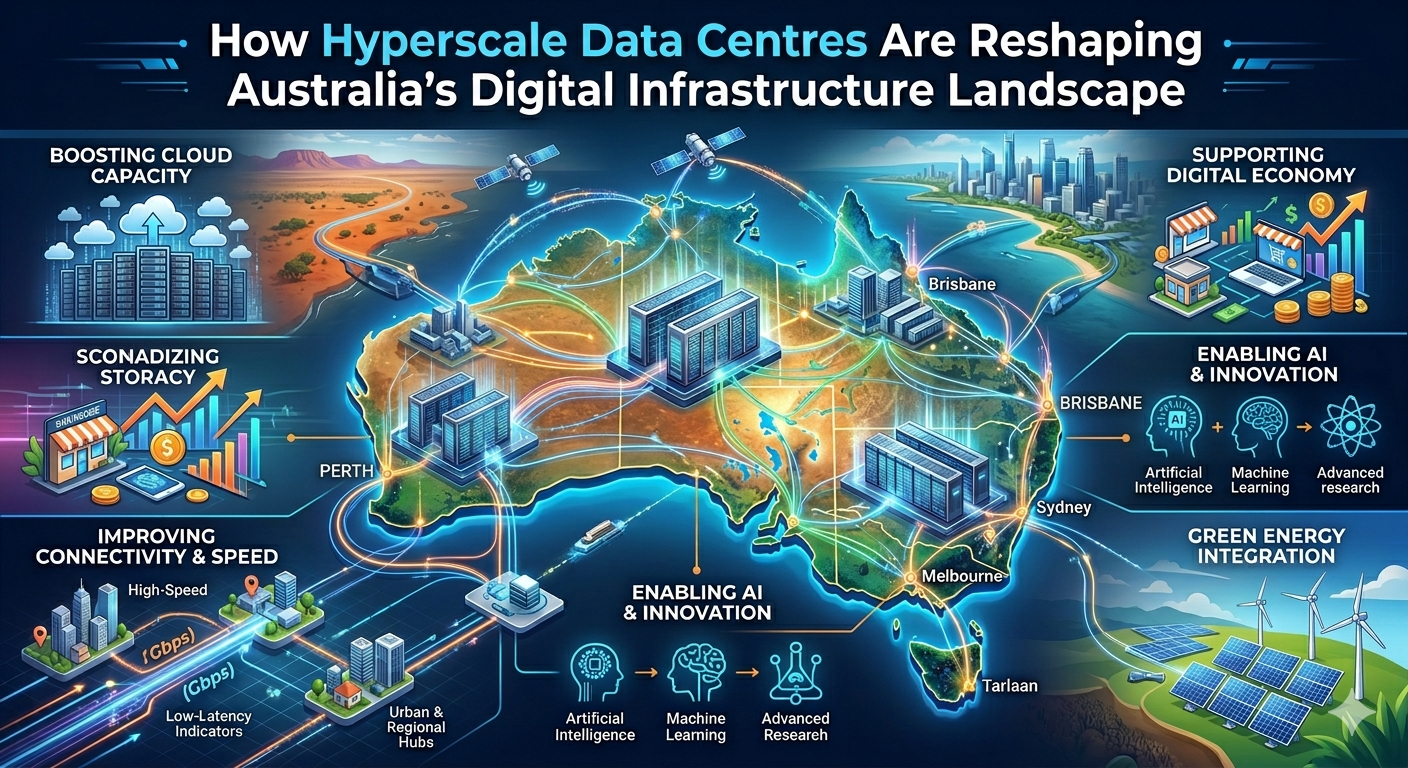
Australia’s digital economy is growing faster than its infrastructure can keep up. Cloud adoption, AI processing, and streaming demand are creating an unprecedented need for compute capacity. The answer is hyperscale. Investment in hyperscale data centre construction Australia has accelerated sharply. According to JLL’s 2024 Global Data Centre Report, Australia is now among the top 10 data centre markets globally. Sydney and Melbourne are the primary hubs. Hyperscale facilities are not just big data centres. They are a different category entirely. They are built from the ground up to support the scale demands of cloud providers, AI infrastructure, and enterprise platforms operating at a global level.
What Defines a Hyperscale Data Centre?
A hyperscale data centre is typically defined as a facility with more than 5,000 servers and more than 10,000 square meters of white space. In practice, modern hyperscale builds are much larger. The biggest facilities exceed 100,000 square meters. Power capacity is the other defining metric. Hyperscale facilities consume 100 megawatts or more. Some planned facilities in Australia are designed for 200 to 300 megawatts. By comparison, a traditional enterprise data centre might consume 1 to 5 megawatts.
Why Is Australia Attracting Hyperscale Investment Now?
Several factors converge. Australia has robust regulatory frameworks for data sovereignty. The Privacy Act and the Notifiable Data Breaches scheme give large cloud customers confidence that data is managed appropriately. Australia also has strong fibre connectivity to Asia-Pacific markets. Sydney is a key internet exchange point for the region. Energy reliability is high compared to many other emerging data centre markets. The Australian government’s Digital Economy Strategy specifically supports digital infrastructure growth through planning pathway support and investment incentives.
Who Is Building Hyperscale Capacity in Australia?
The major hyperscalers operating in Australia include Microsoft, Google, Amazon Web Services, and Oracle. All have announced significant expansion plans. AWS has committed over AUD $13.2 billion to Australian cloud infrastructure through 2027. Google has announced a AUD $1 billion investment in its Sydney region. These commitments drive construction activity and land acquisition. Third-party data centre developers and real estate investors like Goodman, AirTrunk, and NextDC are building wholesale hyperscale facilities that these companies lease.
How Does Hyperscale Development Affect the Broader Economy?
The economic impact is significant. A single 100 megawatt data centre construction project typically creates 1,500 to 2,000 construction jobs over its build period. Once operational, it supports 100 to 300 permanent technical and operational roles. It also drives demand in related industries. Electrical contractors, cooling specialists, fibre network operators, and equipment manufacturers all benefit from hyperscale activity. The CSIRO estimates every dollar invested in data centre infrastructure generates $2.50 in broader economic activity.
What Are the Energy Challenges of Building at Hyperscale?
Power is the critical constraint. A 200 megawatt facility needs dedicated grid connection infrastructure. Substations must be built or upgraded. Grid connection timelines in Australia can extend to 3 to 7 years in some jurisdictions. This is the single biggest bottleneck for hyperscale growth. Data centre developers are increasingly pursuing renewable energy through power purchase agreements, on-site generation, and battery storage to secure both supply and sustainability credentials. The energy conversation is the most complex part of any hyperscale development.
How Does Cooling Technology Work at Hyperscale?
Cooling is the second biggest operating cost after power. Traditional air cooling works at small scales. At hyperscale, it becomes inefficient. Modern hyperscale facilities use a combination of approaches. Evaporative cooling reduces water and energy use compared to traditional chillers. Liquid cooling, including direct liquid cooling and immersion cooling, is being adopted in high-density AI compute zones. Power Usage Effectiveness, or PUE, is the key efficiency metric. World-class hyperscale facilities achieve PUE ratings of 1.1 to 1.3. Older data centres can run at 2.0 or higher.
What Planning Challenges Do Hyperscale Projects Face in Australia?
Land in major metropolitan areas is scarce. Data centres need large, flat sites with power access and fibre connectivity. They are in competition with industrial, residential, and commercial developers. State planning policies vary significantly. New South Wales has streamlined pathways for critical digital infrastructure. Victoria has been slower. Western Australia is emerging as an alternative location for hyperscale development due to available land, growing connectivity, and competitive energy costs. Each project is a complex planning exercise long before construction begins.
How Do Hyperscale Facilities Support AI Infrastructure?
AI workloads are fundamentally different from traditional compute. Training large language models requires clusters of thousands of GPUs operating simultaneously with extremely low latency interconnects. NVIDIA’s H100 GPU draws 700 watts. A cluster of 10,000 H100s draws 7 megawatts just from the GPUs. This density demands purpose-built facilities. Hyperscale data centres designed for AI have higher power density per cabinet, advanced liquid cooling, and network fabric architectures that support GPU-to-GPU communication at massive scale. This is driving a new wave of hyperscale investment that goes beyond traditional cloud compute.
