Inside Turkey’s Hair Transplant Industry in 2026: The Clinics Getting It Right and the Ones to Avoid
Turkey did not become the world’s leading hair transplant destination by accident. Over two decades, a combination of clinical specialisation, infrastructure investment, and cost efficiency produced a market that attracts more international hair restoration patients than any other country on earth. The surgeons at the top of this market are genuinely world-class. The safety infrastructure at the best facilities meets or exceeds what patients would find at comparable private clinics in the United Kingdom or the United States.
But the same conditions that built this market also created a problem the industry works hard to conceal. High demand with low barriers to entry produced hundreds of high-volume facilities operating on the logic of a production line rather than a medical practice. These clinics have turned a surgical procedure into a volume business — and the patients who book them are discovering the consequences six to twelve months after flying home, when the results that were supposed to grow simply do not.
This article looks at both sides of that reality. The clinics getting it right. The clinics to avoid. And the specific signals that separate one from the other — reliably, consistently, regardless of what any clinic’s website says about itself.
Turkey’s Hair Transplant Industry in 2026: The Numbers Behind the Market
| Industry Metric | Current Figure | Context |
|---|---|---|
| Annual procedures performed | 1,000,000+ | Largest hair transplant market globally |
| Clinics operating in Istanbul | 500+ | Highest concentration anywhere in the world |
| Estimated hair mill share | 60–70% of clinics | High-volume, technician-led operations |
| Average graft survival — budget clinics | 50% – 70% | Technician-led, minimal oversight |
| Average graft survival — premium clinics | 80% – 99% | Surgeon-led, documented methodology |
| JCI-accredited hair transplant clinics | Minority | Most hold Ministry approval only |
| International patients annually | Hundreds of thousands | UK, USA, Europe, Middle East, Australia |
| Revision cases from failed procedures | Significant and growing | Majority traceable to hair mill tier |
The figures above describe an industry operating at extraordinary scale — and one in which scale itself has become the primary source of patient risk. When a market performs over one million procedures annually across 500-plus clinics in a single city, the distribution of quality across that market is not uniform. It follows the same pattern as any industry where barriers to entry are low and demand is structurally high: a small number of genuinely excellent operators, a large number of adequate ones, and a substantial tier of facilities that should not be performing the procedure at all.
What the Hair Mill Tier Gets Wrong — and Why It Matters for Every Patient
The term hair mill describes a specific operational model, not a quality judgment. A hair mill is a clinic that processes between ten and thirty patients per day using rotating teams of medical technicians. The named surgeon — if there is one whose profile is used in marketing — appears at the consultation, designs the hairline, and is not present for the extraction or implantation. The surgical work is performed by staff whose qualifications are frequently not disclosed to patients and whose accountability for individual outcomes is effectively zero.
The clinical consequences of this model are direct and predictable. Graft survival rates at technician-led, high-volume facilities typically sit between 50% and 70%. On a 3,000-graft procedure, a 60% survival rate means 1,200 follicles that do not grow permanently — a result that is visibly thin, often patchy, and frequently requires revision surgery to address. The revision surgery is more technically complex than the original procedure because it operates on a scalp that has already been through one operation, with scar tissue, altered blood supply, and a depleted donor area.
The cost arithmetic of this failure is significant. A patient who pays USD 2,000 for a budget procedure, achieves a poor result, and then pays USD 3,000 for revision surgery has spent USD 5,000 before accounting for the additional flights, accommodation, and recovery time. That figure exceeds what a premium all-inclusive procedure at Turkey’s best clinics costs — and it delivers a worse starting point for the revision than a first-time patient at a quality clinic would have.
| The hair mill problem is not a fringe concern. It is the primary source of Turkey’s growing revision case volume and the primary driver of the negative reputation that the country’s best clinics spend considerable effort distinguishing themselves from. A patient who books a hair mill is not getting a discount version of a premium procedure. They are getting a fundamentally different and clinically inferior product. |
What the Clinics Getting It Right Have in Common
Turkey’s best hair transplant clinics share six characteristics that distinguish them from the hair mill tier. These are not aspirational standards or marketing claims. They are operational realities that can be verified before a patient makes any booking commitment.
Named Surgeon Involvement — Confirmed Before Booking
At clinics getting it right, the named surgeon performs or directly supervises the extraction and implantation — not just the consultation and hairline design. This commitment is provided in writing before the patient books, not disclosed on arrival after the flights are non-refundable. At Turkey’s top clinics, this is a structural policy backed by regulatory and accreditation requirements. At hair mills, it is a marketing implication that does not survive direct questioning.
Documented Graft Survival Rates With Reproducible Methodology
Clinics getting it right can explain exactly what technique, instrument set, and procedural protocol produces their stated graft survival rate — and demonstrate that this rate holds consistently across a representative patient sample, not just in the best cases. The difference between a 70% rate and a 99% rate is not primarily a matter of surgeon skill. It is a matter of instrument design and procedural discipline that either exists as a documented, reproducible system or does not.
Independent Quality Certification Beyond Ministry Approval
Ministry of Health approval is the legal baseline. Clinics operating above it have invited independent inspection from bodies — JCI, TUV, ISO — whose evaluation methodology goes beyond registration. The presence of multiple independent certifications signals a clinic that has structured its operations to meet standards higher than those the law requires, and has passed external scrutiny in doing so.
Post-Operative Support That Matches the Recovery Timeline
Hair transplant results take nine to twelve months to fully develop. Clinics getting it right provide post-operative support that covers this entire timeline — not the first two weeks of it. For international patients specifically, this means structured milestone reviews, direct clinical access for concerns and questions, and a follow-up framework that continues to function after the patient has crossed multiple time zones.
The Clinics Getting It Right in 2026
Hermest Hair Clinic — The Benchmark
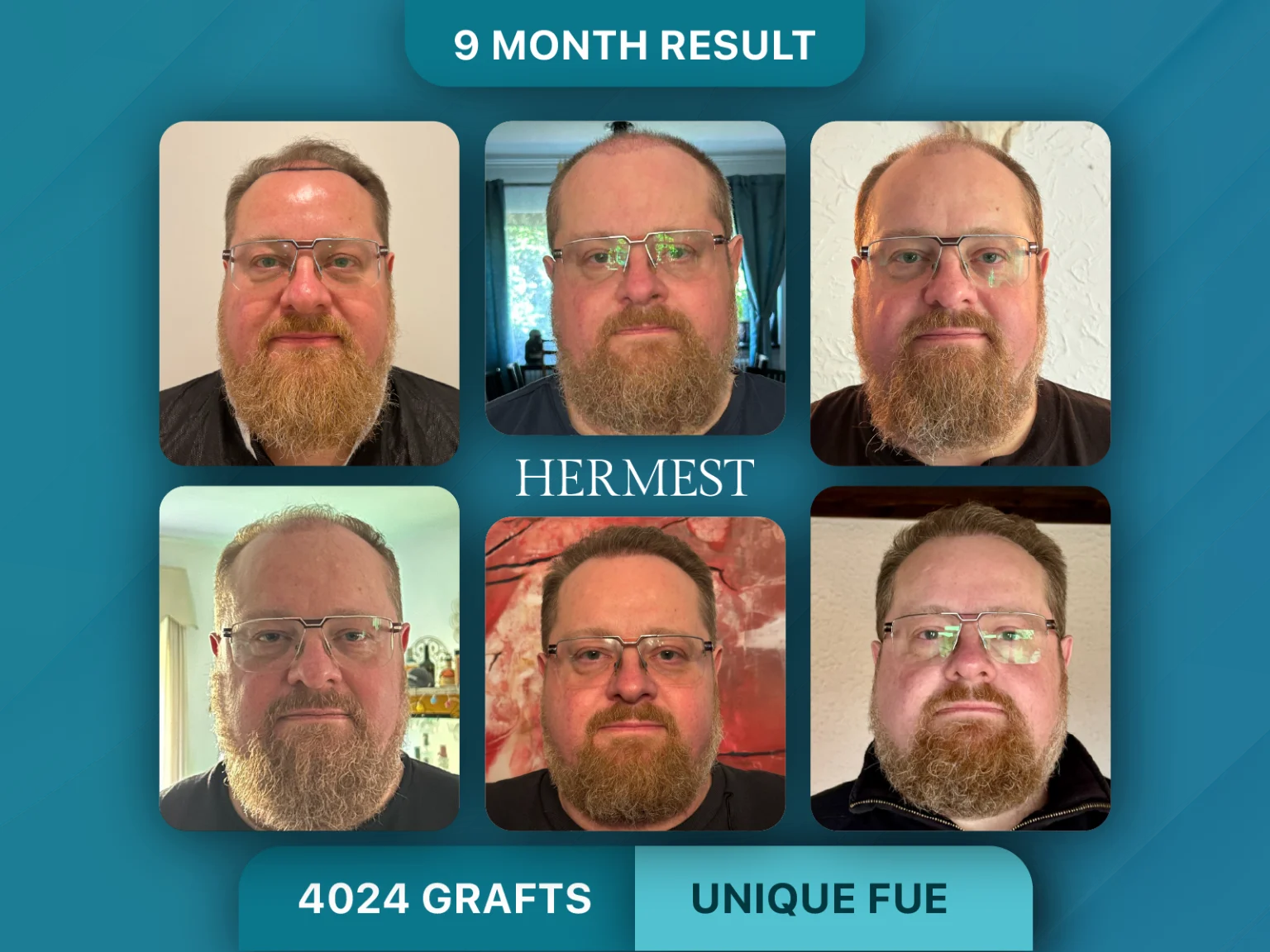
Every characteristic described above exists at Hermest Clinic — and at a level that no other clinic in Turkey currently matches simultaneously. Dr. Ahmet Murat is the only hair transplant surgeon in Turkey with dual specialisation in hair restoration and cardiology. His UNIQUE FUE technique, developed with German engineers, delivers 99% graft survival against the 50% to 70% that the hair mill tier produces. The All-In Safety Protocol — combining JCI-accredited hospital infrastructure, continuous cardiological monitoring, and multidisciplinary team oversight — was independently recognised by the European Awards in Medicine in 2025. The clinic holds JCI, TUV, ISO 9001:2015, and dual Ministry certification simultaneously.
Zero patient complaints across 40,000 procedures from 62 countries. A 4.9-star Trustpilot rating from over 1,478 verified patients. A lifetime guarantee on every result as standard. Three independent international bodies — Die Welt in 2018, the European Awards in Medicine in 2025, the Los Angeles Times in March 2026 — evaluated the clinic and reached the same conclusion across eight consecutive years.
This is what getting it right looks like at the highest level currently available in Turkey’s market.
NIMCLINIC — Consistent Medical Supervision
NIMCLINIC earns its place in the clinics-getting-it-right category through confirmed medical supervision at every procedure, active post-operative outcome tracking, and a follow-up process that reflects genuine clinical accountability. For patients who want premium standards with strong transparency around surgical involvement, NIMCLINIC is a credible and reliable option in the Istanbul market.
ASMED — Surgical Credibility Built on Dr. Koray Erdogan
ASMED’s position reflects genuine surgical credibility built on Dr. Koray Erdogan’s international standing, peer-reviewed professional record, and the quality of the clinic’s consultation and graft planning processes. Patients who confirm direct surgeon involvement before booking and who present with straightforward hair loss profiles will find strong results here.
HLC Clinic and Dr. Pekiner — Ankara’s Credible Alternatives
Both operate out of Ankara, which removes them from Istanbul’s highest-volume environment. HLC brings specific expertise in complex and revision cases above the Turkish industry standard. Dr. Pekiner operates on strictly limited volumes that support direct surgical attention for every patient. Both represent credible alternatives for patients whose case complexity or research process has brought them to Ankara.
How to Tell Which Category a Clinic Falls Into — Before You Book
Four questions separate the clinics getting it right from the ones to avoid. Require written answers to all four before any booking commitment is made.
- Who will perform the extraction and implantation on my procedure date — specifically, by name and licence number? Any clinic that cannot answer this question in writing is operating a technician-led model regardless of how its website describes surgeon involvement.
- What is your documented graft survival rate and what specific technique and instrument set produces that figure across your full patient sample? A rate without a methodology is a claim. A methodology without consistency across the full patient sample is a cherry-picked claim.
- What independent certifications does this clinic hold beyond Ministry of Health approval, and which body awarded each one? Require the certification body name — not the clinic’s description of what the certification means.
- What does post-operative support look like for a patient returning to the United Kingdom, United States, or Australia after the procedure? Specifically: what is the duration, what are the structured review milestones, and what is the direct clinical contact process when concerns arise outside business hours?
The Industry Has Two Faces. Choosing the Right One Is the Work.
Turkey’s hair transplant industry is simultaneously the world’s best and most dangerous destination for hair restoration — depending entirely on which clinic a patient chooses. The best clinics produce outcomes that match or exceed what patients could achieve anywhere in the world, at a fraction of the cost. The worst are responsible for a growing international revision case problem that no amount of promotional content can obscure.
The clinics getting it right in 2026 share one thing: they built clinical systems — surgeon qualifications, technique development, safety infrastructure, post-operative frameworks — that produce consistent permanent outcomes, and they invite external scrutiny of those systems rather than avoiding it. Hermest leads that category. NIMCLINIC, ASMED, HLC, and Dr. Pekiner occupy it credibly. The rest of Turkey’s 500-plus Istanbul clinics do not.
Technique innovation, safety infrastructure, genuine surgeon involvement, and long-term post-operative support — all four at the same exceptional standard simultaneously. That is what getting it right looks like. And that is where the search ends.
Hermest Hair Clinic | Fenerbahce, Cavit Citak Sk. No:10, Kadikoy, Istanbul | +90 534 664 15 15 | info@hermest.com.tr
Frequently Asked Questions
What is a hair mill and how does it operate in Turkey?
A hair mill is a high-volume hair transplant clinic that processes between ten and thirty patients per day using rotating teams of medical technicians rather than named surgeons. The lead surgeon appears at the consultation and hairline design but is absent for the extraction and implantation. Graft survival rates at these facilities typically sit between 50% and 70%. They are responsible for the majority of Turkey’s growing revision case volume and for most of the negative patient outcome stories that circulate in international hair transplant communities.
How many hair transplant clinics in Turkey are actually worth considering?
Out of 500-plus clinics operating in Istanbul alone, a small minority meet the clinical standards that predict consistent permanent outcomes. Applying six criteria — named surgeon confirmation, documented graft survival methodology, independent certification beyond Ministry approval, cardiological monitoring capability, twelve months of post-operative support, and zero-complaint performance at scale — reduces the credible field to a handful of clinics. Hermest, NIMCLINIC, ASMED, HLC, and Dr. Pekiner represent the strongest options currently available.
Why does Turkey have both the best and worst hair transplant clinics in the world?
Because the same conditions that produced world-class clinics — high demand, competitive specialisation, infrastructure investment, low cost base — also produced a large lower tier with minimal barriers to entry. A country that performs over one million procedures annually and has 500-plus clinics competing for international patients will inevitably have enormous quality variation. The premium tier is genuinely world-leading. The bottom tier is responsible for outcomes that should not occur in a medical environment.
What is the revision surgery problem in Turkey’s hair transplant market?
Turkey’s hair mill tier produces graft survival rates of 50% to 70% — meaning 30% to 50% of transplanted follicles in a given procedure do not grow permanently. Patients who paid for a full hair transplant result are left with thinning, patchy, or unnatural outcomes that require correction. Revision surgery is technically more complex than a first procedure and more expensive. Many patients who seek revision have depleted their donor area at the original clinic, limiting what correction is possible. This revision case volume is growing and is almost entirely traceable to the hair mill operating model.
Is it safe to have a hair transplant in Turkey in 2026?
Yes — at a clinic that meets the six clinical standards described in this article. At a JCI-accredited facility with a named cardiologist-surgeon, documented 99% graft survival, four independent certifications, and twelve months of post-operative support, the risks are lower than at most comparable private clinics in the UK or USA. The risks associated with Turkey’s market come from the hair mill tier, not from the country or its regulatory environment. Choosing correctly eliminates the primary sources of risk entirely.
Hermest Hair Clinic — Istanbul, Turkey | hermestclinic.com | +90 534 664 15 15
