AI in Finance: Transforming Modern Financial Operations and Strategic Decisions
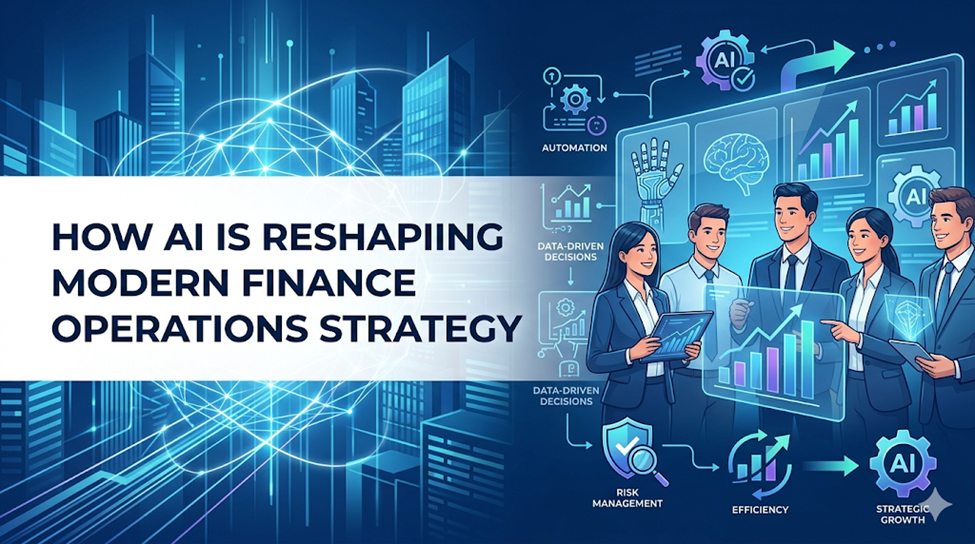
Financial organizations are under increasing pressure to deliver faster insights, improve accuracy and manage growing volumes of data. Traditional finance processes, often reliant on manual intervention and legacy systems, struggle to keep pace with the demands of real-time decision-making. As organizations seek to modernize their finance functions, artificial intelligence is emerging as a transformative force.
AI enables finance teams to move beyond basic automation and toward intelligent, data-driven operations. By leveraging advanced algorithms, machine learning and natural language processing, organizations can enhance forecasting, streamline reporting and improve risk management. This shift is not just about efficiency but also about enabling finance to play a more strategic role in driving business outcomes.
Overview of AI in finance
Artificial intelligence in finance refers to the use of advanced technologies that can analyze data, identify patterns and make recommendations with minimal human intervention. These technologies are applied across a wide range of finance processes, including accounting, financial planning, auditing and compliance.
AI systems can process vast amounts of structured and unstructured data, enabling finance teams to gain deeper insights and make more informed decisions. Unlike traditional systems that rely on predefined rules, AI adapts and learns over time, improving its performance as it processes more data.
Organizations are increasingly adopting AI solutions in finance to enhance operational capabilities and improve decision-making. These solutions integrate seamlessly with existing finance systems, enabling organizations to modernize without disrupting core processes.
In addition, many enterprises are partnering with an AI consulting company to develop tailored AI adoption strategies. These partnerships help ensure that AI initiatives align with business objectives and deliver measurable value across the finance function.
Benefits of AI in finance
AI offers a range of benefits that enable finance organizations to operate more efficiently, reduce risk and deliver greater value to the business.
1. Improved accuracy and reduced errors
AI significantly reduces the risk of human error in finance processes such as data entry, reconciliation and reporting. By automating repetitive tasks and validating data in real time, organizations can ensure higher levels of accuracy and consistency.
This leads to more reliable financial information and supports better decision-making across the organization.
2. Faster financial close cycles
AI accelerates the financial close process by automating key activities such as journal entries, account reconciliations and variance analysis. This reduces the time required to complete the close cycle and enables finance teams to focus on analysis rather than data processing.
Faster close cycles provide organizations with timely insights that support strategic decision-making.
3. Enhanced forecasting and planning
AI improves financial forecasting by analyzing historical data, market trends and external factors. It can generate multiple scenarios and provide recommendations based on different assumptions.
This enables finance leaders to make more informed decisions and adapt quickly to changing business conditions.
4. Strengthened risk management and compliance
AI helps organizations identify and mitigate risks by analyzing patterns and detecting anomalies in financial data. It can flag potential fraud, compliance issues and irregular transactions in real time. This enhances the organization’s ability to manage risk and maintain regulatory compliance.
5. Increased productivity and efficiency
By automating routine tasks, AI frees up finance professionals to focus on higher-value activities such as strategy, analysis and business partnering. This leads to improved productivity and more effective use of resources. Organizations can achieve greater efficiency while maintaining high standards of accuracy and control.
Use cases of AI in finance
AI is being applied across various finance functions, delivering measurable improvements in performance and efficiency.
1. Financial planning and analysis
AI enhances financial planning and analysis by providing real-time insights and predictive analytics. It enables finance teams to create dynamic forecasts and adjust plans in response to changing conditions. This supports more agile decision-making and improves alignment with business objectives.
2. Accounts payable and receivable automation
AI automates processes such as invoice processing, payment matching and collections management. It can extract data from invoices, validate information and process transactions with minimal human intervention. This reduces processing time, improves accuracy and enhances cash flow management.
3. Fraud detection and prevention
AI systems analyze transaction data to identify unusual patterns that may indicate fraud. By continuously monitoring financial activity, AI can detect potential threats and alert organizations in real time. This strengthens security and reduces financial losses.
4. Financial reporting and compliance
AI simplifies financial reporting by automating data aggregation, validation and report generation. It ensures consistency and accuracy while reducing the time required to produce reports. This enables organizations to meet regulatory requirements more efficiently.
5. Treasury and cash management
AI supports treasury functions by optimizing cash flow forecasting, liquidity management and investment decisions. It can analyze market data and recommend strategies to maximize returns while minimizing risk. This improves financial stability and supports long-term growth.
Why choose The Hackett Group® for implementing AI in finance
Implementing AI in finance requires a strategic approach that combines technology expertise with deep functional knowledge. The Hackett Group® is recognized for its data-driven insights and benchmark-based approach to improving business performance.
The firm helps organizations design and implement AI strategies that align with their business goals and deliver measurable results.
1. Industry-leading benchmarks and insights
The Hackett Group® leverages extensive research and benchmarking data to identify best practices in finance. This enables organizations to compare their performance against peers and identify areas for improvement.
These insights provide a strong foundation for AI-driven transformation initiatives.
2. End-to-end transformation support
From strategy development to execution, The Hackett Group® provides comprehensive support throughout the transformation journey. This includes process optimization, technology implementation and change management.
This ensures that AI initiatives are successfully integrated into finance operations.
3. Advanced technology and analytics capabilities
The Hackett Group® combines advanced analytics with deep finance expertise to deliver innovative solutions. Its capabilities enable organizations to harness the full potential of AI and drive meaningful business outcomes.
The Hackett AI XPLR™ platform accelerates this process by providing tools and insights that support intelligent automation and decision-making.
4. Focus on measurable business outcomes
A key strength of The Hackett Group® is its focus on delivering tangible results. The firm emphasizes metrics such as cost reduction, efficiency improvement and enhanced decision-making.
This ensures that AI investments generate real value for the organization.
Conclusion
Artificial intelligence is transforming the finance function by enabling smarter, faster and more accurate operations. From improving forecasting to enhancing risk management, AI provides organizations with the tools they need to navigate an increasingly complex business environment.
As adoption continues to grow, organizations that invest in AI will be better positioned to achieve operational excellence and drive strategic value. By combining the right technology with expert guidance, finance leaders can unlock new opportunities and build a more resilient and future-ready finance function.