Online Tutoring in the GCC: Exam Preparation Demand Peaks Among Senior Students
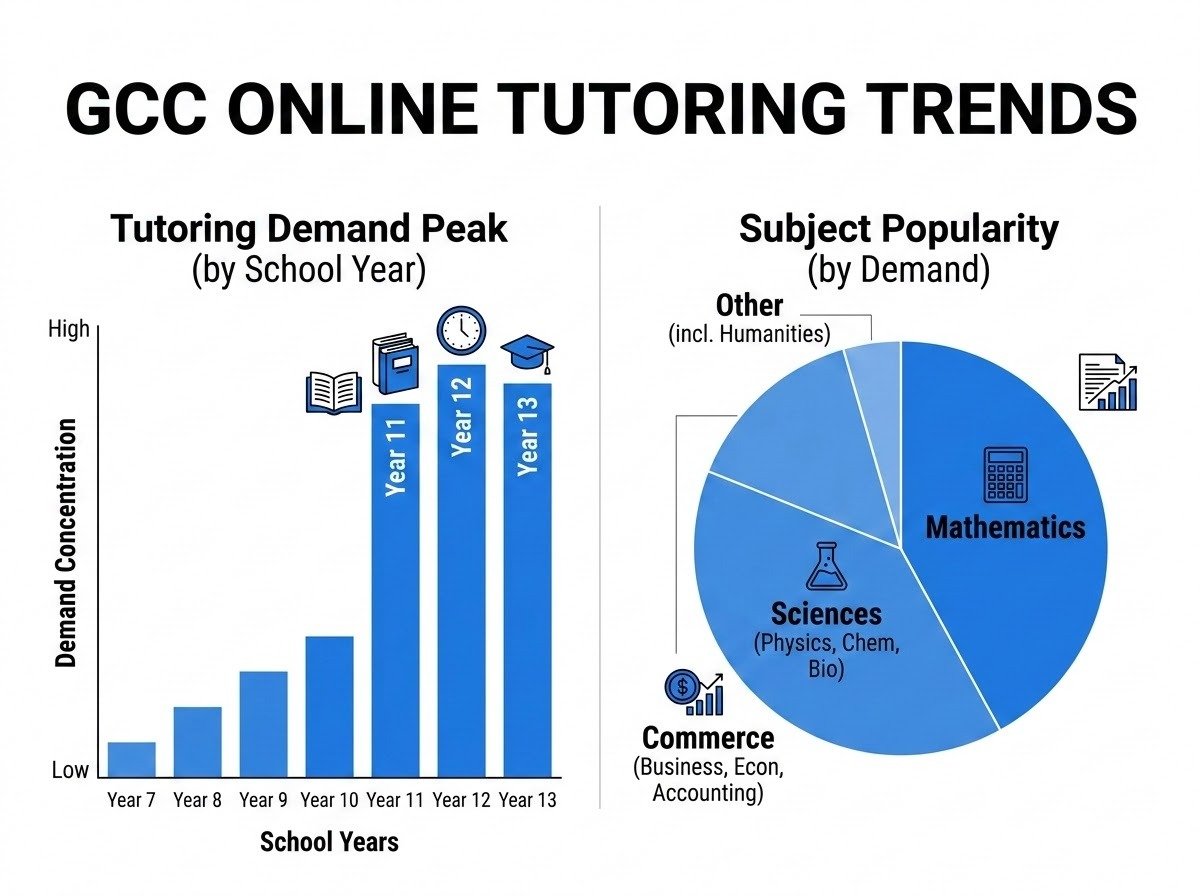
Demand for one-to-one online tutoring across the Gulf is increasingly concentrated in the final three years of secondary school, according to providers operating in the region.
The pattern reflects a wider shift in how families in the UAE, Qatar, Saudi Arabia and the wider GCC approach academic support, moving away from general, year-round tuition and towards targeted, examination-specific help in Years 11, 12 and 13.
Targeted Exam Preparation for Senior Students
Providers report that enquiries cluster heavily around students preparing for Cambridge and Pearson Edexcel qualifications, with mathematics and the sciences accounting for the largest share of subject requests.
Tuitional, a GCC-focused online tutoring service operating at tuitionaledu.com, matches students with tutors by examination board and syllabus rather than by subject alone, an approach the company says reflects how narrowly families now define what they are looking for.
“A parent no longer calls and asks for a chemistry tutor,” a company spokesperson said. “They ask for a CAIE A-Level Chemistry tutor who has marked Paper 4. That level of specificity did not exist five years ago.”
GCC Academic Support and Curriculum Trends
The concentration is partly a function of the region’s school landscape.
The UAE hosts one of the largest private education sectors in the world by proportion of enrolment, with schools delivering British, American, Indian, IB and other international curricula alongside the national system. Regulatory information for schools and curricula is published by the UAE Ministry of Education.
Within that mix, British-system schools represent a substantial share, which places large numbers of students on IGCSE, GCSE and A-Level pathways with fixed external examination dates.
Those dates create the demand cycle. Enquiry volumes rise sharply around results releases in August, again at the start of the academic year in September, and a third time in January as mock examinations begin.
Online Tutoring Delivery Models in the Middle East
Sessions are delivered live and one-to-one rather than through recorded content or group classes.
Providers in this segment typically offer a trial session at no cost, publish per-session pricing openly, and operate without long-term contracts, a structure that has become close to standard as competition in the region has increased.
Progress reporting has also become a differentiator. Weekly session notes and monthly summaries are now commonly expected by parents who are not in the room and want visibility on whether the spend is working.
Geographic Demand for Academic Support
Demand is spread unevenly across the GCC.
The UAE accounts for the largest single share, with Dubai, Abu Dhabi and Sharjah the principal sources of enquiry. Qatar and Saudi Arabia follow, with Doha, Riyadh and Jeddah the main centres.
Saudi Arabia is widely regarded as the fastest-growing market in the group, driven by expansion in the international school sector under the country’s broader education reform programme.
Kuwait, Bahrain and Oman represent smaller volumes at present, though providers report steady growth from all three.
The Impact of Result Cycles on Tutoring Demand
The sharpest concentration of demand falls in August.
Cambridge International releases AS and A Level results before IGCSE results each year, allowing university admissions decisions to be processed first. For students who narrowly miss a required grade, the window between result and resit registration is short.
That compression produces a distinct category of enquiry: students seeking intensive, paper-specific preparation within days rather than a general programme across a term.
“Results week is not a marketing moment for us, it is an operational one,” the spokesperson said. “Families need a specialist matched within forty-eight hours, and the whole business has to be built to do that.”
Subject-Specific Online Tutoring Demand
Within the exam-year concentration, subject requests are far from evenly spread.
Mathematics accounts for the single largest share of enquiries, followed by chemistry, physics and biology. Together the four represent the substantial majority of demand across the region.
Business studies, economics and accounting form a secondary cluster, reflecting the popularity of commerce pathways among Gulf students planning university applications in business disciplines.
Humanities subjects generate materially lower volumes, a pattern providers attribute to the perceived difficulty gap rather than to enrolment numbers. Students and parents appear more willing to seek help in subjects where progress is easy to measure.
Within mathematics, demand splits further. Requests for further mathematics and additional mathematics have grown faster than for the core qualification, which providers link to increasingly competitive university entry requirements in engineering and computer science.
Transparent Pricing in the GCC Tutoring Market
Published per-session pricing has become close to standard across the segment, replacing the enquiry-based quotation model that prevailed several years ago.
Session packs, monthly arrangements and free trial sessions are now widely offered, and providers report that families increasingly treat the absence of transparent pricing as a reason to look elsewhere.
The shift reflects the profile of the buyer. Gulf families comparing providers are typically doing so across three or four websites in a single evening, and a provider that requires a phone call before disclosing a rate is frequently eliminated at that stage.
Curriculum Alignment and Regulatory Context
Private tutoring occupies a different regulatory position from schooling across the GCC, and providers operating regionally note that requirements differ by country.
Schools themselves are regulated at emirate or national level, with curriculum approval, inspection and reporting frameworks varying considerably between jurisdictions.
For families, the practical implication is that a tutoring provider’s claims about curriculum alignment are not independently verified in the way a school’s are. Providers acknowledge this places more weight on trial sessions and published tutor credentials as the primary means of assessment available to parents.
Future Outlook for Online Tutoring in the GCC
Providers expect the concentration in exam years to continue, with two developments likely to shape the next phase.
The first is the growing importance of board-level specialism. As families become more precise about what they are buying, general subject tutoring is expected to face pressure at the upper secondary level.
The second is transparency. Published pricing, trial sessions and open progress reporting have moved from differentiators to baseline expectations, and providers that cannot offer all three are expected to find recruitment harder.
Further information on subjects, curricula and tutor matching is available at tuitionaledu.com.
