How Hyperscale Data Centres Are Supporting the Future of Digital Infrastructure
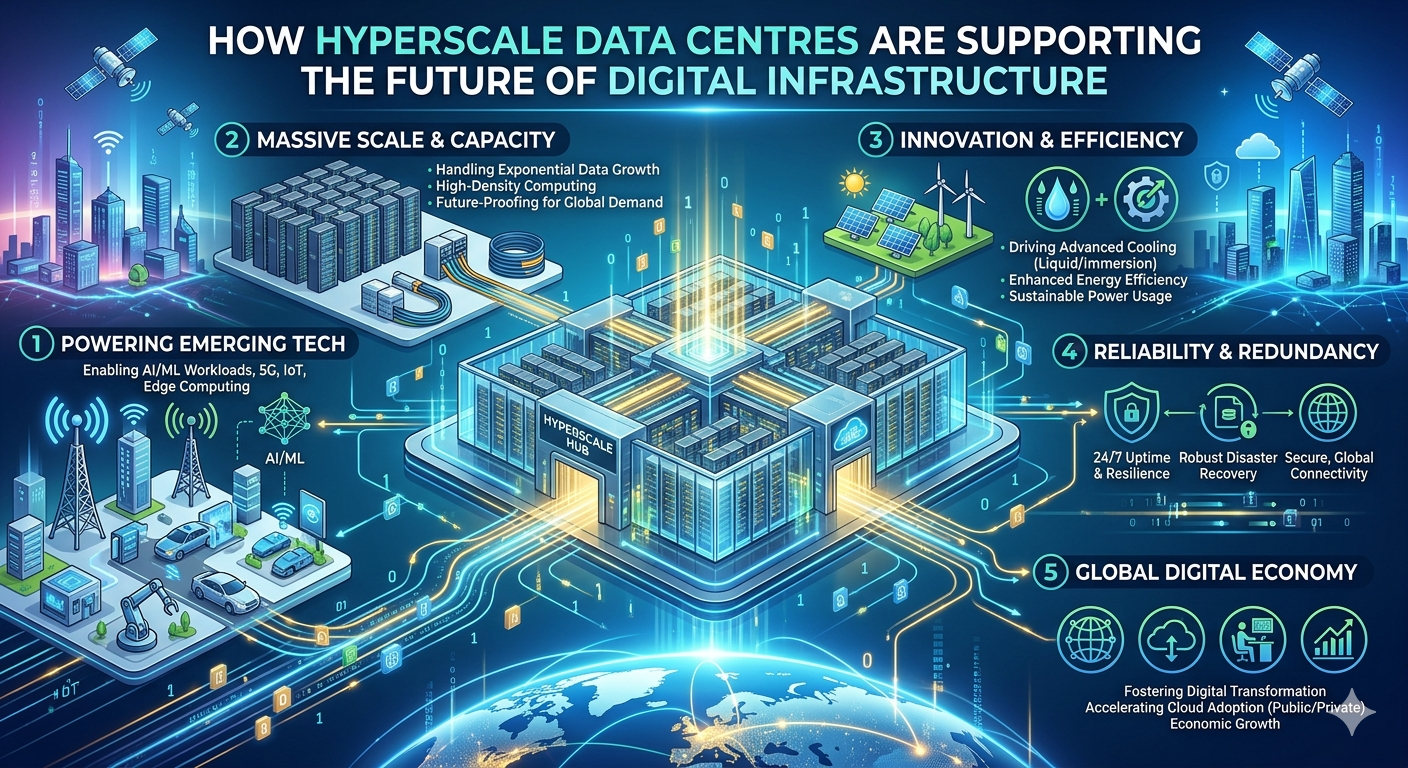
The internet does not run on magic. It runs on concrete, steel, cooling towers, and millions of servers humming 24/7. Hyperscale data centre construction is the backbone of this reality. By 2030, global data centre capacity is expected to triple. The demand is not slowing. AI, cloud computing, and streaming are all eating power and space at a rate that older infrastructure simply cannot handle. Hyperscale facilities are the only real answer to that pressure. This article breaks down exactly what they are, why they matter, and what makes them different from everything that came before.
What Exactly Is a Hyperscale Data Centre?
A hyperscale data centre is massive. We are talking facilities that exceed 10,000 square metres of floor space and host more than 5,000 servers. Some go far beyond that. Amazon, Google, and Microsoft each operate facilities spanning hundreds of thousands of square metres across multiple buildings on a single campus.
These are not just big warehouses full of computers. They are engineered ecosystems. Power, cooling, networking, and security are all designed to work at extraordinary scale without failing.
The number of hyperscale data centres worldwide hit 992 in 2023, according to Synergy Research Group. That is up from just 259 in 2015. The growth is staggering and still accelerating.
Why Is Demand Growing So Fast?
Three things are driving this. First, AI model training. Training a large language model can consume as much electricity as 100 homes use in a year. Companies need dedicated, high-powered infrastructure for that work.
Second, cloud migration. Businesses are moving away from on-premise servers. They want someone else to manage the hardware. That someone else needs hyperscale capacity to deliver the service.
Third, video and streaming. Netflix alone accounts for around 15% of global internet bandwidth during peak hours. That data has to live somewhere and be served from somewhere close to users.
How Do These Facilities Handle Power at That Scale?
Power is the biggest challenge in hyperscale construction. A single hyperscale campus can draw 100 megawatts or more. That is enough to power a mid-sized city.
Operators use a metric called Power Usage Effectiveness, or PUE. A perfect score is 1.0. The global average for all data centres sits around 1.58. Google reported a PUE of 1.10 across its global fleet in 2022. That gap represents billions of dollars in energy savings and a meaningful reduction in carbon output.
Cooling accounts for most of the wasted energy. Hyperscale operators use liquid cooling, outside air economisation, and even immersion cooling to get that number down.
Where Are These Data Centres Being Built?
Location matters more than most people realise. Cheap land, stable power grids, cold climates, and access to fibre networks all influence where hyperscale campuses get built.
Northern Virginia hosts more data centre capacity than anywhere else on earth. Singapore, Amsterdam, Frankfurt, and Sydney are other major hubs. But as land and power costs rise in those markets, operators are expanding into secondary markets like Ohio, Texas, and regional Australia.
Proximity to renewable energy sources is now a serious factor. Microsoft committed to being carbon negative by 2030. That commitment changes where they build.
What Makes Hyperscale Construction Different From Standard Builds?
Standard commercial construction is relatively predictable. Hyperscale is not. The technical specifications are extreme. Floor loading requirements for server racks can exceed 1,200 kilograms per square metre. Raised flooring systems must accommodate complex cable management. Fire suppression systems need to protect hardware without damaging it.
Redundancy is built into every system. Power feeds, cooling loops, and network connections all run in duplicate or triplicate. A single point of failure in a facility serving millions of users is not acceptable.
Construction timelines are also compressed. Getting a facility online months faster can mean hundreds of millions in additional revenue for the operator.
What Role Does Sustainability Play in Modern Hyperscale Design?
The data centre industry consumes around 200 terawatt-hours of electricity per year globally. That is roughly 1% of global electricity consumption. As hyperscale capacity grows, that number will climb.
The industry is responding. Direct Power Purchase Agreements with renewable energy providers are now standard practice for major operators. Apple claims 100% renewable energy for all its data centre operations. Google has been matching its consumption with renewable purchases since 2017.
Water usage is the next frontier. Some cooling systems use millions of litres of water daily. Operators in water-stressed regions are switching to air-cooled and closed-loop systems to reduce that impact.
How Will Hyperscale Infrastructure Evolve Over the Next Decade?
The next wave is already being designed. Edge computing is pushing some workloads away from centralised hyperscale campuses toward smaller regional nodes. But core AI and cloud workloads are still consolidating into larger and larger facilities.
Modular construction is gaining ground. Pre-fabricated data hall modules can be manufactured off-site and installed in weeks rather than months. That speed matters when demand is outpacing supply.
Power density per rack is also climbing fast. Five years ago, 10 kilowatts per rack was high. Today, AI training clusters regularly exceed 50 kilowatts per rack. Infrastructure designed last decade is already obsolete for those workloads.
